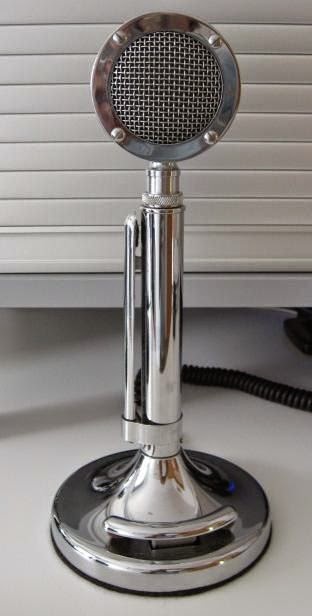
Edward's D104 converted


Edward's D104 converted

We convert Edward's D104 to an amplified mic so it could work with his Icom radio. Enjoy Stickman

Original Circuit (Amplified D-104)


VA3AGV.com - ANDRE - Amateur Radio - Canada


Figure 1 In the original circuit, the first stage of the D-104 amplifier provides the load for the mike element. Originally it uses a common NPN bi-polar transistor.

The microphone element is connected through a .01uf capacitor to the base of the first transistor. A 1 Meg resistor is connected from 9v to the base to bias the transistor for linear operation.

The transistor emitter is grounded through a 150-k ohm resistor. A 0.1 uf capacitor also connects to the emitter. This couples the audio output into the next stage providing for DC inter-stage voltage isolation. This is a very common emitter follower configuration.

A 450 pf. (00047) uf capacitor is connected from the emitter to the base. The purpose of this “boot-strapping” capacitor is to create positive feedback from the emitter to the base. This artificially raises the base impedance of this input.

The collector connects to board foil that supplies 9v.

There is a second stage that feeds the mike cord. This is not needed with the FET modification as the FET amplifier provides plenty of output for most applications. I have found that the sound is better without this second stage so it is eliminated in the modification.

Andre's D104 modded and repairs


Here we serviced 2- D104 lolly pop mics and we also changed up the tunes of them. Enjoy Stickman

Andre's D104 modded and repairs

D104 Silver Eagle


Got a mint D104 Silver Eagle for my Cobra 139XLR and got my A99 up in the air at 58 feet for better TX and RX Hope to get back to the woods real soon

Cleaning a D104 Chrome Microphone

My HF Astatic D104 likes to get a little rusty after a few months of being down here in the swamp. I used some "Never Dull" chrome cleaner and polish from Walmart, but the real trick is the Dremel tool. I applied a little Never Dull, buffed it in, and used the soft buffing pad on the Dremel to take off the rust. For the bigger rust spots, I used my tiniest precision flat head screwdriver as a scraper. I very gently scratched the rust spots off and smoothed the area with the Dremel.


Astatic D-104 Silver Eagle Mic Mods Connection to Yaesu

Astatic D-104 Silver Eagle Mic Mods Connection to Yaesu

VA3AGV.com - ANDRE - Amateur Radio - Canada

Astatic D-104 Silver Eagle Mic Mods Connection to Yaesu


The Astatic D-104 desktop microphone has a very sharp sound due to it’s crystal microphone capsule and it has also has a great preamp to get enough voice level in the transceiver that gives you a great advantage for DX. Also the sharp modulation is heard better through noise on your QSOs.

But the mic doesn’t sound well on all transceivers cause of their internal high-, low- or band-pass AF filters. On most modern transceivers the modulation sound too much sharp or tiny cause of the lost of basses.

Astatic D-104 Silver Eagle Mic Modifications

The D-104 has been around since the 30’s and is still popular today for communications. The current ones are still pretty much the same except that in the early 70’s a two- transistor pre amp was added to the base. The D-104 is considered by many to be the coolest looking mike around.

The early elements used a Rochelle salts crystal but later a ceramic crystal was used to make the element more rugged. These elements are unique in that the diaphragm is convex instead of concave. Although these diaphragms were made of aluminum foil, Astatic used an ingenious method of placing batting in contact with the element. This eliminated the “tin” sound of these elements and they are capable of a surprisingly good sound. The peaky sound that we sometimes hear from these mikes is due to improper loading, not the diaphragm material.
Without the pre amp, these microphones sound very good with tube equipment that provided a very high impedance load to the element.

VA3AGV.com - ANDRE - Amateur Radio - Canada
With solid state equipment these elements do not sound as good by themselves. Even with a high impedance load such as 50k ohms, they are often high pitched and peaky sounding. With some applications this high pitched sound is preferred. But sometimes this results in a thin or nasal, very middy, unnatural sound. These elements exhibit very low impedance at very high frequencies and very, very high impedance at low frequencies. Even at 50K ohms, output voltage is swamped at low frequencies making the sound high-pitched.

If we bridge the element with a very, very high impedance load, several Meg ohms, it will sound much smoother, be more natural and have low end while still retaining presence.